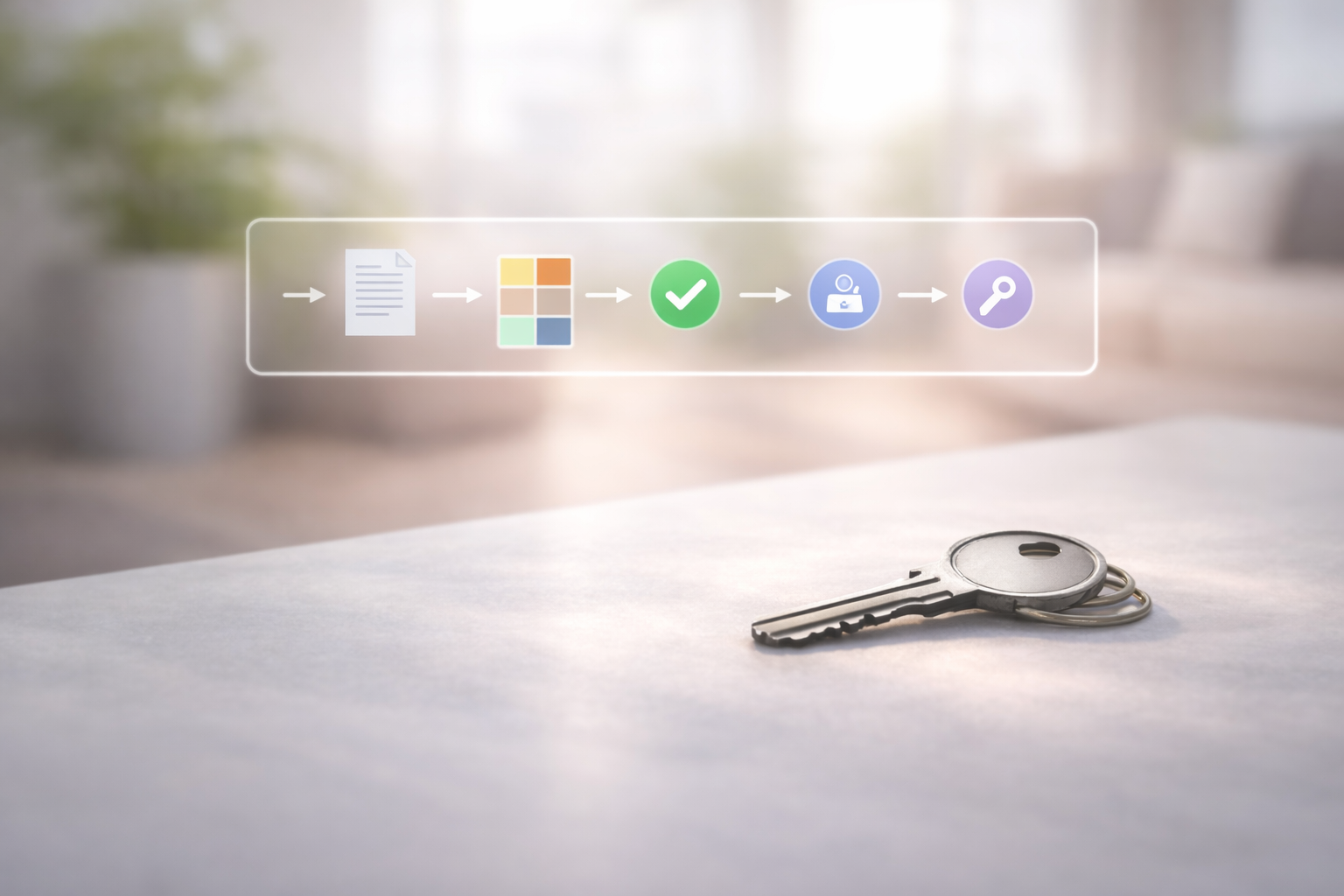
Buyer management is one of the most underestimated disciplines in residential construction. It happens in the background, between contract signing and handover — and it determines whether a project is profitable or just exhausting. This guide covers everything you need to know.
What buyer management actually covers
Buyer management refers to all processes for coordinating individual fit-out decisions with end buyers after purchase contract signing. In a typical residential project, each buyer needs to make 30–80 individual selections: kitchen layout, bathroom tiles, flooring, paint colours, sanitary fittings, electrical outlet positions, and more.
Beyond selections, buyer management encompasses:
- Approval workflows — capturing and storing buyer sign-offs on decisions in a legally defensible way
- Budget tracking — monitoring each buyer's actual versus budgeted additional costs in real time
- Supplier briefings — passing confirmed selections to kitchen, bathroom, flooring and other suppliers with enough detail to order and install correctly
- Communication — responding to buyer enquiries, sharing deadlines, and managing changes
Why residential construction is particularly complex
Unlike commercial construction, where a single client makes most decisions centrally, residential projects have as many different priorities as they have buyers. A 60-unit project means 60 separate sets of expectations, 60 separate selection processes, and 60 potential sources of disputes at handover.
Swiss residential construction adds specific complexity. Buyers typically have high expectations for personalisation, the legal framework around digital signatures and data protection (revDSG) creates compliance obligations, and multi-supplier coordination across tight construction schedules leaves little margin for error.
The four core processes
1. Selections management
Every buyer works through a catalogue of standard and upgrade options. The project manager's job is to ensure decisions are made within deadlines, captured accurately, and passed to the right suppliers before procurement cutoffs. In manual workflows, this typically involves 3–5 email exchanges per selection, with risk of version confusion if a buyer revises a choice.
2. Approval workflows
A confirmed selection is only valuable if there is a clear, timestamped record that the buyer approved it. Verbal agreements and informal email confirmations create exposure: if a buyer disputes a tile choice at handover, you need documented evidence. Best practice is a defined approval workflow that produces a PDF or digitally signed record at every stage.
3. Budget transparency
Additional costs accumulate gradually: an upgrade here, a scope change there. Without real-time budget tracking, buyers are surprised by the final settlement figure — and surprised buyers become difficult handovers. Project managers who provide buyers with live access to their own cost status reduce settlement disputes significantly.
4. Supplier briefings
Confirmed selections need to reach trade contractors and suppliers with enough lead time to order, manufacture, and deliver within the construction programme. An incomplete briefing — missing dimensions, wrong product codes, unclear specification — creates a back-and-forth clarification loop that consumes days and risks delays.
Digital vs manual: the real cost
Most project managers currently manage buyer management in a combination of email, spreadsheets, and PDF attachments. This works at small scale. In a 20-unit project, a capable project manager can track everything manually with a few hours per week. At 60 units, the same approach requires a dedicated full-time resource. At 100+ units, it breaks down entirely.
The hidden cost of manual buyer management includes:
- 8–12 hours per week answering repeat enquiries (deadlines, cost summaries, confirmation of selections)
- 2–4 hours per week chasing missing decisions from buyers who have missed deadlines
- 3–6 hours per unit creating supplier briefing documents from raw data
- Unquantified time at handover managing disputes caused by documentation gaps
A centralised platform eliminates most of this. The measurable impact: project managers handling 40–60% more units per head, with fewer errors and less overtime.
Legal requirements you need to know
Switzerland's revised Federal Act on Data Protection (revDSG, in force since September 2023) imposes specific obligations on entities processing personal data. In the context of buyer management, this means:
- Buyers' personal data (name, address, contact details, financial data) must be processed on a legally compliant basis and protected accordingly
- Digital approval records must be stored securely and be retrievable for the period required by Swiss construction law (typically 5–10 years after handover)
- Data stored in the cloud must comply with Swiss or EU-equivalent data protection standards
Beyond data protection, Swiss construction projects typically involve multiple approval stages where buyer consent needs to be documented to have legal standing in a dispute. A digital audit trail — showing who approved what, when, and in what version — is increasingly expected as standard practice.
What good buyer management looks like
High-performing project teams share several characteristics in how they handle buyer management:
- Single source of truth. All decisions, approvals, and communications for a buyer are accessible in one place — not scattered across email threads, CRM notes, and local spreadsheets.
- Buyer self-service. Buyers can view their own selections, pending decisions, budget status, and deadlines without calling or emailing the project team. This alone eliminates the majority of inbound queries.
- Structured handover documentation. At completion, a complete handover pack — covering all selections, approvals, and cost summaries — is produced automatically from the project data, not assembled manually.
- Integrated supplier briefings. Supplier briefing documents are generated directly from confirmed buyer selections, eliminating transcription errors and reducing briefing time per unit from hours to minutes.
How to get started
If you are currently managing buyer management manually, the first step is a process audit. Map how a single selection currently travels from buyer decision to supplier briefing, counting the steps and the people involved. Identify where decisions are undocumented, where versions get confused, and where you have had near-misses or actual disputes.
This baseline makes the ROI of a digital solution immediately visible — and gives you the evidence needed to justify the investment to stakeholders.
Most teams that make the switch see a payback period of under three months on a 60-unit project, measured by reduced project management hours alone.