The skilled labour shortage is real, and hiring your way out of overload is expensive. The more sustainable path is creating capacity — and buyer management is one of the highest-leverage places to do it. Here are five concrete ways a digital platform changes the equation.
The capacity problem in numbers
A typical project manager in Swiss residential construction handles between 1 and 3 projects simultaneously. At 40–60 units per project, buyer management alone consumes 10–15 hours per week — mostly on inbound queries, email follow-ups, and manual document creation. That is roughly a quarter of the working week, before counting site visits, design coordination, and stakeholder management.
Teams that have digitalised buyer management report that the same project managers can handle 40–60% more units with no increase in hours and no reduction in quality. Here is why.
Reason 1: Buyer queries drop by 80%
The single largest drain on project manager time is answering questions that buyers could answer themselves if they had access to their own data. "What did we decide for the bathroom tiles?" "What is my current additional cost budget?" "What is the deadline for the kitchen selection?" Every one of these questions requires a project manager to find the relevant file, cross-reference it, and compose a reply.
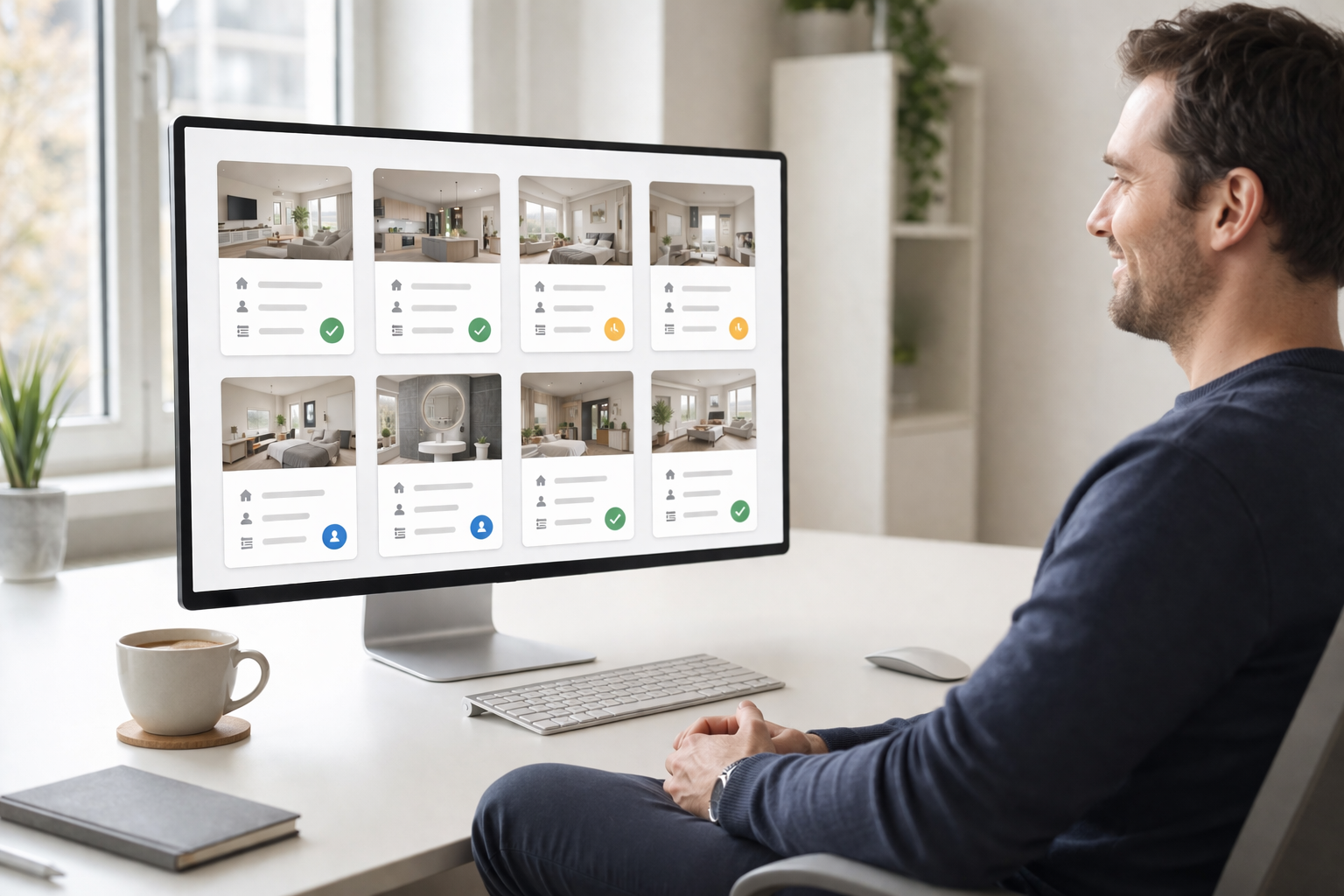
When buyers have a portal where they can view their own selections, pending decisions, budget status, and key dates, most of these questions never reach the project manager. Teams that implement buyer portals consistently report an 80–90% reduction in routine inbound queries within the first project cycle.
Reason 2: Deadline misses become visible — and preventable
In a manual workflow, tracking which buyers have not yet confirmed their kitchen selection across 60 units means maintaining a spreadsheet and manually chasing each one. It is error-prone, time-consuming, and reactive.
A digital platform handles this automatically: you see at a glance which decisions are outstanding, which deadlines are at risk, and the system sends automated reminders to buyers before deadlines are missed. The project manager's role shifts from chasing to monitoring — a fraction of the effort.
Reason 3: Scale without adding headcount
The traditional model is linear: more units mean more workload, which means more staff. Digital buyer management breaks this relationship. The administrative overhead per unit decreases as project volume increases, because the platform handles the routine work that would otherwise scale linearly with unit count.
In practice, this means a team that currently manages 120 units across 3 projects can take on a fourth project at 60 units without hiring an additional project coordinator — because the capacity freed up by the platform absorbs the incremental load.
Reason 4: Handover disputes become rare
Handover disputes are expensive. Even a single disputed selection — a buyer who claims they approved a different kitchen than the one installed — costs days of project manager time to resolve, and potentially significant remediation costs if it escalates. Multiply that risk by 60 buyers, and the tail risk is material.
When every selection has a timestamped approval record, handover disputes lose their basis. Buyers cannot credibly dispute a decision that is documented with their name, the exact specification they approved, and the date they approved it. The frequency of handover disputes drops sharply — which means significantly less time spent on post-handover issues.
Reason 5: Real-time cost transparency eliminates settlement surprises
Additional cost disputes at final settlement are a major source of project manager time and stress. When buyers are not continuously informed of their cost position, a large final invoice comes as a shock — and shocks generate pushback, negotiation, and sometimes legal challenges.
Real-time budget tracking, visible to buyers through the portal, eliminates this dynamic. Buyers always know where they stand. They make decisions with full awareness of cost consequences. The final settlement figure is never a surprise. This removes an entire category of dispute from the post-handover phase.
The cumulative effect
These five gains compound. Fewer inbound queries, automated deadline management, no handover disputes, and no settlement surprises add up to a project manager who spends the majority of their time on actual project work rather than administrative overhead. A conservative estimate suggests that a typical project manager in a digitalised team has 8–12 hours per week of capacity freed up — enough to manage one additional mid-sized project.
For a team of five project managers, that is the equivalent of hiring a sixth. Without the hiring cost, the onboarding time, or the additional overhead.